

Home | Blog | Construction industry | Connectivity in construction management: integrating existing systems
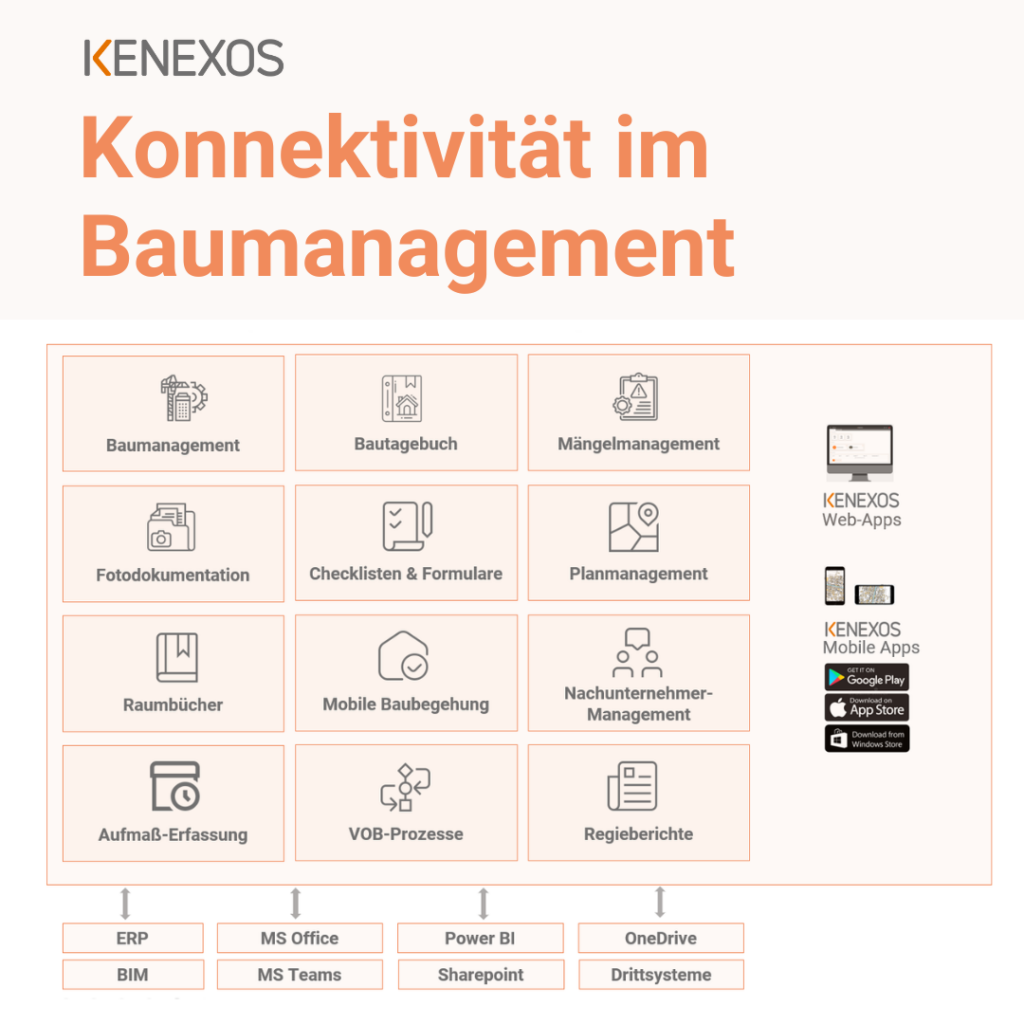
Connectivity in construction management
In the modern construction industry, the efficiency of project management is crucial to success.
A key element here is the seamless connectivity and integration of the various software systems used in the industry.
In this article, we explain the importance of this connectivity and how it increases efficiency and productivity in construction projects.
The challenge of integration
Various software systems are used for different tasks in the construction industry. The most important systems include
- ERP (Enterprise Resource Planning) systems such as SAP, Microsoft Business Central and Oracle, which support the management of business processes.
- BIM (Building Information Modeling) software such as Autodesk Revit and Bentley Systems, which facilitate the planning and execution of construction projects through digital 3D models.
- Facility management systems such as IBM Maximo and Planon, which support the management and maintenance of buildings and facilities.
- Project management tools such as Primavera P6 and Procore, which facilitate the planning, implementation and tracking of construction projects.
- Planning software such as Bluebeam Revu and Trimble WinEst, which are used to create cost estimates and construction plans.
- Office tools such as Microsoft Office 365, Microsoft Teams or OneDrive, which support daily communication and collaboration within the team.
Using these systems in isolation often leads to information silos and inefficient workflows. The challenge is to connect these different systems to ensure a smooth flow of information.
Increasing productivity through integration:
A study by McKinsey & Company shows that construction companies that have integrated digital solutions such as BIM and ERP can see an increase in productivity of up to 20 %.
(Source: McKinsey & Company).
Current developments and trends
- Integration of BIM and IoT
The integration of Building Information Modeling (BIM) and the Internet of Things (IoT) enables even more precise planning and monitoring of construction projects.BIM models can be updated in real time, while IoT sensors on the construction site provide data that is fed into the project management software. These technologies help to reduce the error rate and increase efficiency.
(Source: MDPI).
The solution: A modern, open API interface concept
To enable the seamless integration of all these systems, you need a modern, open API interface concept that enables data exchange between the various systems.
This connectivity ensures that all relevant data and information can be exchanged.
Advantages of integrating your systems:
Increased transparency
All project participants have access to up-to-date data and documents at all times. This promotes collaboration and improves decision-making.
Efficient processes
The automation and synchronization of processes reduces errors and speeds up workflows. This saves time and resources.
Cost savings
Optimized resource planning and management lead to a reduction in overall costs.
Better decision-making
Real-time data analyses and reports support well-founded decisions that ensure project success.
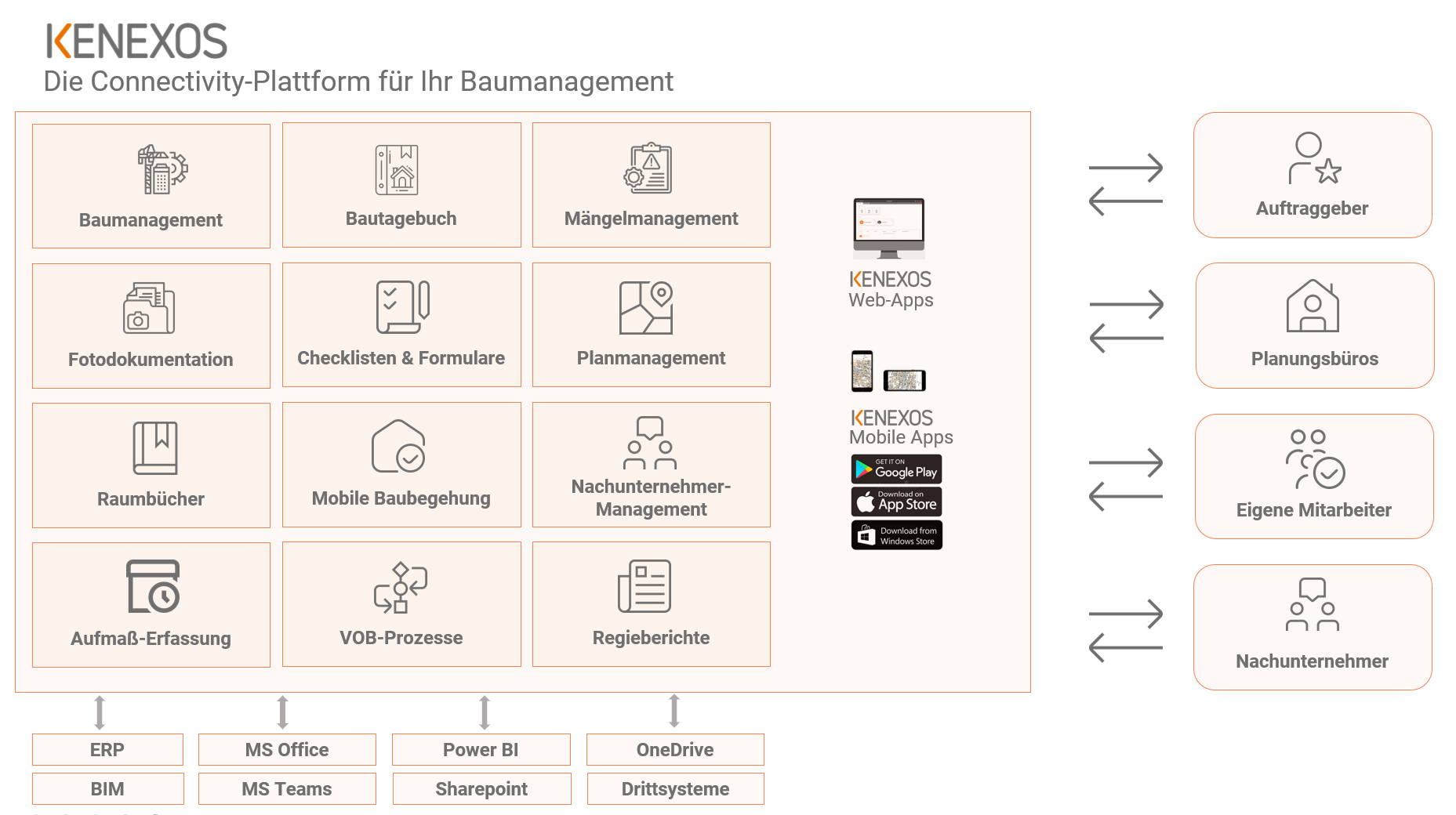
The KENEXOS® connectivity platform
The cloud-based KENEXOS® connectivity platform offers numerous modern functions and technologies that complement and extend the benefits mentioned above:
Seamless connection of your systems
Our platform can be connected to all common systems in the construction industry via a modern API interface concept. This includes ERP systems, BIM software, additional project management tools, as well as facility management software, CRM systems and accounting software. This creates the crucial seamless collaboration and efficient project management.
Data acquisition via app – according to your individual specifications
Some of your (VOB) processes require good and complete documentation. That’s why your data entry screens must be flexibly adaptable and also fit your project structure.
With KENEXOS® SmartForms, you can customize and design all input masks, queries and your necessary documents according to your individual specifications. And all this in combination with your individual project structure. This allows you to efficiently create your optimum documentation during ongoing construction operations.
Native app for all platforms
The KENEXOS® mobile app is available on all platforms: iOS, Android or Windows. And it is also available as a PWA (Progressive Web App). You don’t have to worry about which mobile device your employees and external partners are using.
Display your overall plans on your mobile device.
Thanks to KENEXOS® Tile Maps technology, we can also display large and complex plans with zoom options down to the smallest detail on your mobile device.
Find out more about the benefits of the KENEXOS® connectivity platform and how we can support your company. Contact us for a demo or a personal meeting.
Connectivity starts with the process data
A good connectivity solution fits seamlessly into your IT infrastructure. This starts with your process data: Machines, devices and, of course, all sensors and measuring points. KENEXOS® has the IoT module for this.
Kreutzpointner Business Software GmbH
Sigmund-Riefler-Bogen 2
81829 Munich
Phone: +49 (0) 89 944176-0
Fax: +49 (0) 89 944176-499
E-mail: info@kenexos.com

